
Предпросмотр проекта
Полную презентацию можно получить по почте после оплаты
Что вы получите
10–15 слайдов
Профессиональный дизайн
Текст для каждого слайда
Формат — PPTX
Готовая презентация за несколько минут
Основная информация
Название
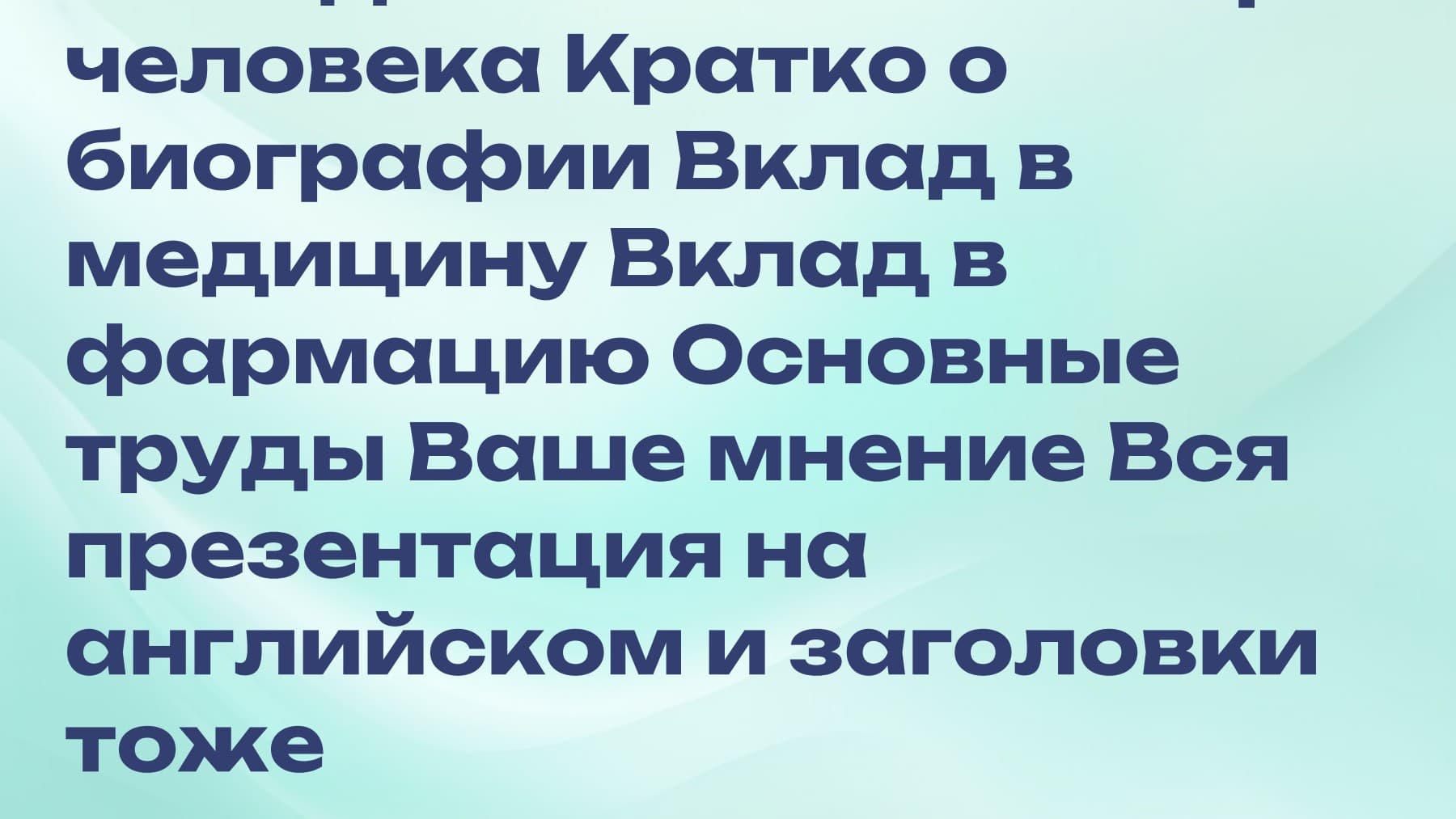
Клавдий Гален План: Про человека Кратко о биографии Вклад в медицину Вклад в фармацию Основные труды Ваше мнение Вся презентация на английском и заголовки тоже
Краткое описание
This presentation provides an overview of Claudius Galen's life, his contributions to medicine and pharmacy, and his main works. It highlights his influence on medical science and his lasting legacy.
Текст презентации
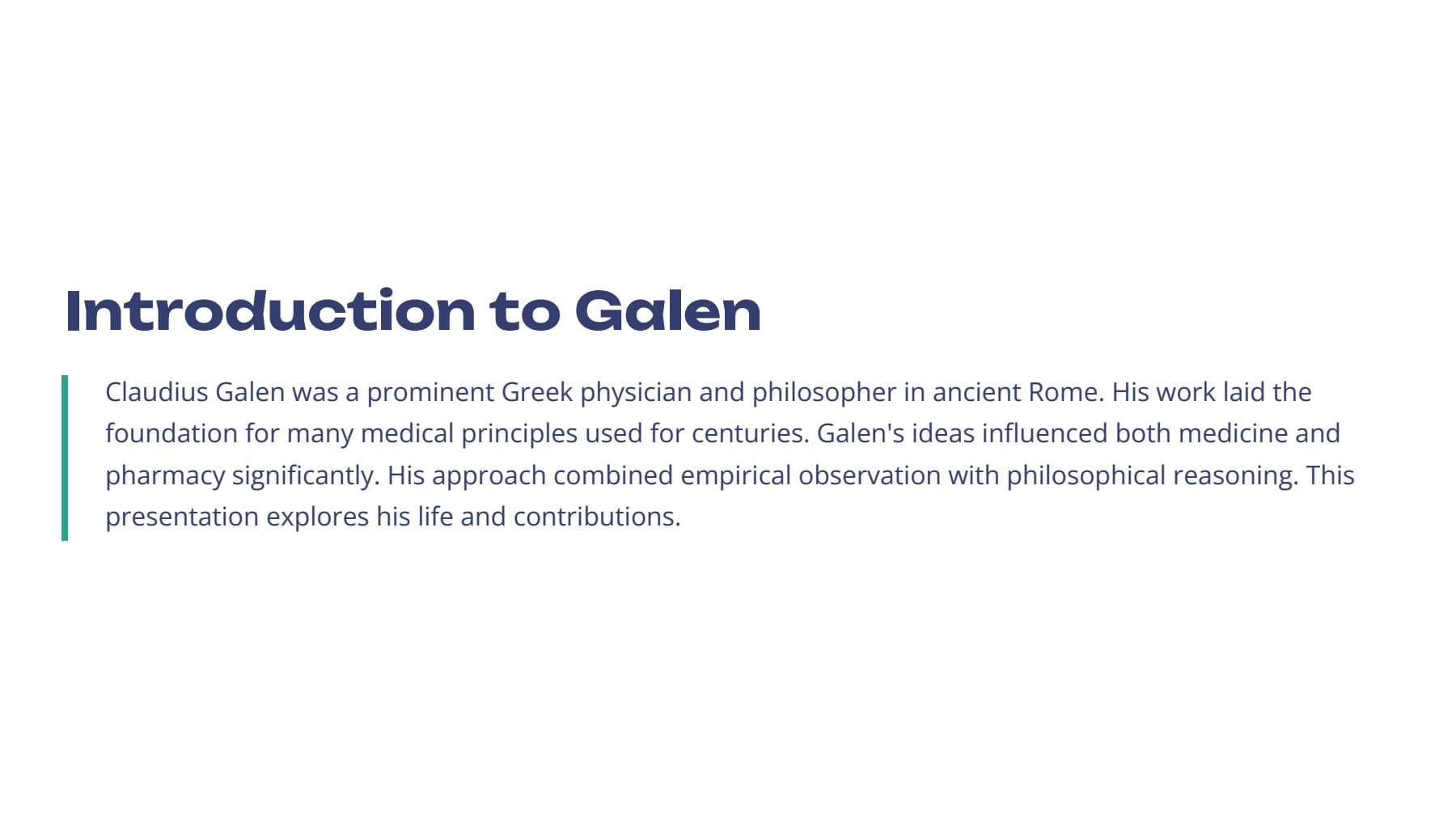
1. Introduction to Galen
Claudius Galen was a prominent Greek physician and philosopher in ancient Rome. His work laid the foundation for many medical principles used for centuries. Galen's ideas influenced both medicine and pharmacy significantly. His approach combined empirical observation with philosophical reasoning. This presentation explores his life and contributions.
2. Biographical Overview
Galen was born in 129 AD in Pergamon, Asia Minor. He studied medicine in Alexandria and later worked in Rome. His career spanned over four decades, during which he treated many notable patients. Galen's writings reflect his extensive studies and practical experience. He died around 200 AD, leaving a vast legacy.
3. Contributions to Medicine
Galen advanced medical knowledge through detailed anatomical studies and clinical observations. He emphasized the importance of understanding the human body and its functions. His theories on humors and bodily fluids influenced medical practice for centuries. Galen also contributed to surgical techniques and medical diagnostics. His work shaped medieval and Renaissance medicine.
4. Contributions to Pharmacy
Galen's work in pharmacy involved the preparation and use of medicinal compounds. He documented numerous herbal remedies and drug formulations. His pharmacological texts guided physicians in prescribing treatments. Galen emphasized the importance of combining natural ingredients with scientific methods. His influence extended to apothecaries and pharmacists of later periods.
5. Main Works
Galen authored hundreds of texts on medicine, anatomy, and philosophy. His most famous works include 'On the Natural Faculties' and 'The Method of Healing.' These writings systematized medical knowledge and introduced new concepts. His texts were used as standard references for centuries. Galen's work bridged Greek philosophy and practical medicine.
6. Legacy and Impact
Galen's ideas dominated Western medicine for over a millennium. His anatomical descriptions remained authoritative until the Renaissance. His approach combined philosophy with empirical observation. Many of his theories were later challenged and refined. Nonetheless, his influence is evident in modern medical science. His legacy endures through his writings and teachings.
7. Critical Perspectives
While Galen's contributions were significant, some of his theories were incorrect or outdated. His reliance on animal dissection limited understanding of human anatomy. Critics note that some of his ideas hindered medical progress for centuries. Despite this, his methodological approach set a foundation for scientific inquiry. His work exemplifies the importance of observation and documentation.
8. Personal Reflection
Galen's work represents a milestone in medical history, combining scientific curiosity with philosophical inquiry. His dedication to understanding the human body has inspired generations of physicians. Recognizing both his achievements and limitations provides a balanced view. His influence demonstrates the importance of continuous learning and adaptation in medicine. Overall, Galen remains a pivotal figure in medical history.
9. Summary and Conclusions
Claudius Galen was a pioneering figure whose work shaped medicine and pharmacy for centuries. His detailed studies and writings created a foundation for future medical advances. Despite some inaccuracies, his methodological approach remains relevant. Galen's legacy highlights the enduring importance of scientific observation and documentation. His contributions continue to be recognized worldwide.