
Загружаем работу
Учтём индивидуальные пожелания, критерии и методичку вашего преподавателя.

Полную презентацию можно получить по почте после оплаты
Посмотрите пример — что говорить по первым слайдам, прежде чем оплатить.
10–15 слайдов
Профессиональный дизайн
Понятная структура
Формат — PPTX
Готовая презентация за несколько минут
Нажмите, если это про вас — ответ анонимный
Название
Авиакомпания Пегас написать на английском языке 9страниц
Краткое описание
This presentation provides an overview of Pegasus Airlines, a Turkish low-cost carrier. It covers the company's history, services, fleet, and future plans to give a comprehensive understanding of its role in the aviation industry.
Текст презентации
1. Introduction to Pegasus Airlines
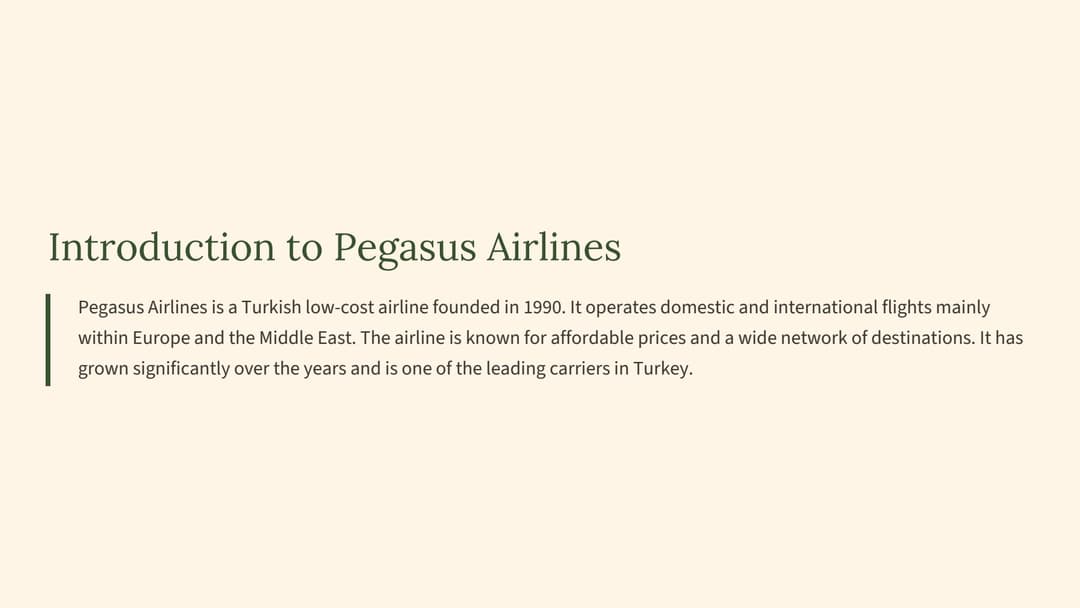
Pegasus Airlines is a Turkish low-cost airline founded in 1990. It operates domestic and international flights mainly within Europe and the Middle East. The airline is known for affordable prices and a wide network of destinations. It has grown significantly over the years and is one of the leading carriers in Turkey.
2. Company History
Pegasus Airlines started as a charter airline and later transitioned to a low-cost carrier model. It expanded its route network gradually, opening new bases and increasing flight frequencies. The airline adopted a customer-focused approach, offering competitive prices and efficient service. Over time, it became a major player in the regional aviation market.
3. Fleet and Aircraft
Pegasus Airlines operates a modern fleet primarily composed of Airbus A320 family aircraft. The fleet size has grown to include dozens of planes, allowing for extensive route coverage. The airline emphasizes fuel efficiency and reliability in its fleet management. Maintenance and safety standards are a priority to ensure smooth operations.
4. Destinations and Network
Pegasus Airlines serves over 100 destinations across Europe, the Middle East, and North Africa. Its network includes major cities and popular tourist destinations. The airline offers both scheduled and seasonal flights to meet passenger demand. Connectivity and affordability are key features of its route network.
5. Business Model
The airline operates on a low-cost business model, focusing on cost efficiency and high aircraft utilization. It offers basic fare options with additional charges for extras like baggage and meals. This approach allows Pegasus to keep ticket prices low and attract a broad customer base. Ancillary revenues contribute significantly to its profitability.
6. Customer Service and Experience
Pegasus Airlines aims to provide a straightforward and efficient travel experience. While it offers minimal onboard services, it maintains a focus on punctuality and safety. The airline provides online check-in and digital services to enhance convenience. Customer feedback is used to improve service quality.
7. Safety and Regulations
Safety is a top priority for Pegasus Airlines, adhering to international aviation standards and regulations. The airline undergoes regular inspections and audits to ensure compliance. Crew training and safety procedures are continuously updated. The airline's safety record is strong, contributing to passenger trust.
8. Environmental Initiatives
Pegasus Airlines is committed to reducing its environmental impact through fuel-efficient aircraft and operational practices. It promotes recycling and waste reduction onboard. The airline also explores new technologies to improve sustainability. Environmental responsibility is integrated into its corporate strategy.
9. Future Plans and Growth
Pegasus Airlines plans to expand its route network and modernize its fleet further. It aims to increase passenger numbers and strengthen its market position. Investment in digital technology and customer service is a priority. The airline seeks sustainable growth while maintaining low-cost operations.
10. Conclusion
Pegasus Airlines has established itself as a key player in the low-cost airline sector in Turkey and beyond. Its focus on affordability, safety, and efficiency has driven its success. The airline continues to grow and adapt to changing market conditions. Future strategies aim to sustain its competitive edge and expand its global presence.
Посмотрите другие работы, которые создали пользователи.
Этот проект изучает различные виды индикаторов, их свойства и применение. В нем рассматриваются способы определения и использования индикаторов в разных сферах жизни.
Презентация рассказывает о географическом положении, природных особенностях и населении Баргузинского района. Рассматриваются основные достопримечательности и экономическая деятельность региона.
Проект изучает особенности и роль акул в морской экосистеме, а также отношение людей к этим морским хищникам. В работе рассматриваются их виды, повадки и влияние на окружающую среду.
Проект исследует роль короля Генриха 5 в ходе Столетней войны между Англией и Францией. В работе рассматриваются его военные кампании и влияние на ход войны.
Презентация рассматривает роль сновидений в понимании подсознательных процессов. Обсуждаются основные теории и методы анализа сновидений. Цель — показать, как сновидения помогают понять внутренний мир человека.
Проект изучает использование трехмерного моделирования для разработки логотипов компаний. В нем рассматриваются методы создания объемных изображений и их применение в брендинге.
Презентация рассказывает о деятельности мамы как предпринимателя в сфере пассажирских перевозок. Рассматриваются особенности бизнеса, его организация и важность для общества. Также представлены основные этапы развития и перспективы развития бизнеса.
Данное пособие предназначено для воспитателей, работающих с детьми с задержкой психического развития, и включает игровые методики для развития речи с элементами триз. В работе рассматриваются теоретические основы, аналитика текущих практик и проектные рекомендации.
Этот проект изучает правила и особенности обособления различных частей в предложениях. В нем рассматриваются случаи правильного использования запятых и других знаков при обособлении.
Презентация рассказывает о роли бактерий в организме человека, их видах и влиянии на здоровье. Рассматриваются как полезные, так и вредные бактерии, а также способы их взаимодействия с человеком.
Опишите тему — нейросеть соберёт презентацию со слайдами, тезисами и выводами.