
Загружаем работу
Учтём индивидуальные пожелания, критерии и методичку вашего преподавателя.
Полную презентацию можно получить по почте после оплаты
Посмотрите пример — что говорить по первым слайдам, прежде чем оплатить.
10–15 слайдов
Профессиональный дизайн
Понятная структура
Формат — PPTX
Готовая презентация за несколько минут
Нажмите, если это про вас — ответ анонимный
Название
Людвиг ван Бетховен. На английском языке
Краткое описание
This presentation provides an overview of Ludwig van Beethoven's life, works, and influence on classical music. It covers his early years, major compositions, and legacy in the music world.
Текст презентации
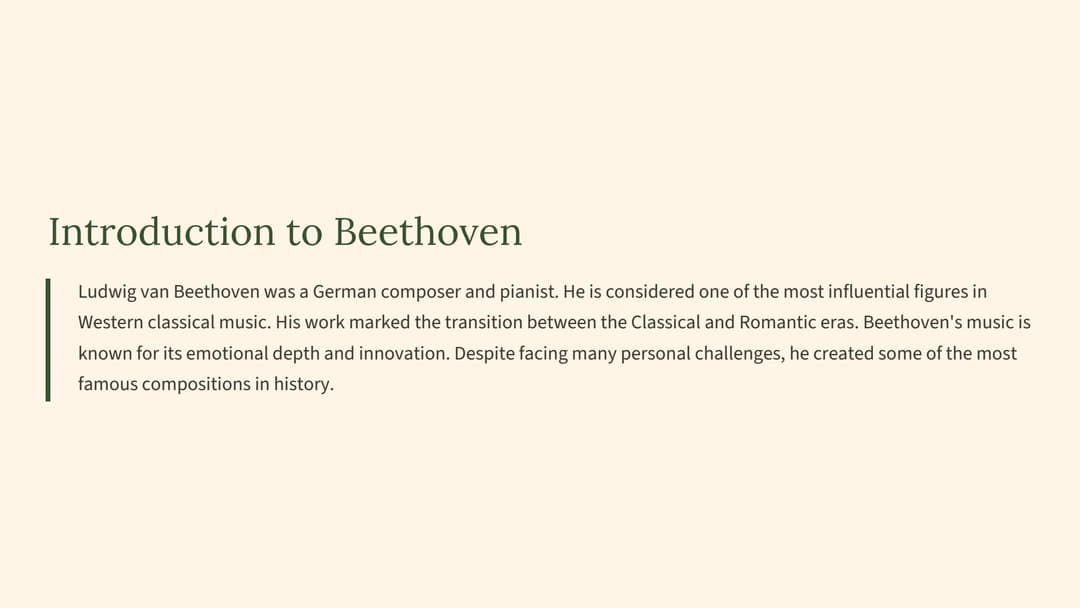
1. Introduction to Beethoven
Ludwig van Beethoven was a German composer and pianist. He is considered one of the most influential figures in Western classical music. His work marked the transition between the Classical and Romantic eras. Beethoven's music is known for its emotional depth and innovation. Despite facing many personal challenges, he created some of the most famous compositions in history.
2. Early Life and Background
Beethoven was born in Bonn, Germany, in 1770. He showed musical talent from a young age and was trained by his father and other teachers. His early performances gained recognition, and he moved to Vienna to pursue his career. His family background was modest, but his talent opened many opportunities. Early in his life, he was influenced by composers like Mozart and Haydn.
3. Musical Education and Influences
Beethoven studied with several prominent composers of his time. He was deeply influenced by the Classical style but sought to develop his own voice. His exposure to different musical ideas helped shape his innovative approach. Beethoven admired Mozart and considered him a major influence. His early compositions reflected the classical traditions of the time.
4. Major Works and Compositions
Beethoven composed symphonies, sonatas, quartets, and operas. Some of his most famous works include the Ninth Symphony, Moonlight Sonata, and Fidelio. His compositions are known for their complexity and emotional power. He expanded the size and scope of symphonies and sonatas. His music often conveyed deep personal and philosophical themes.
5. Challenges and Personal Life
Beethoven faced many personal challenges, including hearing loss. His deafness gradually worsened over time, yet he continued to compose. He had difficult relationships with family and friends. Despite these struggles, his creative output remained prolific. His personal experiences influenced the emotional depth of his music.
6. Innovations in Music
Beethoven introduced new ideas in harmony, form, and expression. He broke traditional rules to create more expressive music. His use of dynamics and structure was revolutionary. Beethoven's innovations paved the way for Romantic music. His work demonstrated the power of music to express human emotion.
7. Beethoven’s Legacy and Influence
Beethoven's music had a profound impact on future composers. He expanded the possibilities of musical form and expression. His works continue to be performed and studied worldwide. Beethoven is seen as a symbol of artistic independence and resilience. His influence is evident in many genres beyond classical music.
8. Later Years and Final Compositions
In his later years, Beethoven composed some of his most profound works. His Ninth Symphony includes the famous choral finale. Despite his deafness, he continued to create groundbreaking music. His final compositions reflect a deep philosophical outlook. These works are considered some of the greatest in music history.
9. Conclusion and Legacy
Ludwig van Beethoven remains a towering figure in music. His life story is one of perseverance and innovation. His compositions continue to inspire musicians and audiences worldwide. Beethoven's influence extends beyond music into culture and art. His legacy is a testament to the power of creativity and resilience.
Посмотрите другие работы, которые создали пользователи.
Этот проект рассказывает о боксе как виде спорта и его особенностях. В нем изучаются правила, история и влияние бокса на здоровье и развитие человека.
Проект рассказывает о развитии Олимпийских игр с древних времен до наших дней. В нем изучаются основные этапы и важные события этого спортивного праздника.
Реферат посвящен изучению уникальной анатомической особенности сердца — трехпредсердной структуры. В работе рассматриваются причины возникновения этого состояния, его особенности и возможные последствия для организма. Анализ важен для понимания развития сердечно-сосудистых заболеваний и методов их диагностики. Исследование помогает расширить знания о вариациях сердечной анатомии и их клиническом значении.
Этот проект изучает основы генетики и наследственности, а также влияние генов на признаки человека. В рамках работы проводится социальный опрос и анализ научных данных.
Этот проект изучает методы и подходы, которые помогают учиться быстрее и лучше. В нем рассматриваются теоретические основы и практические советы по обучению.
Данный реферат посвящен изучению методов и стратегий защиты бретской крепости, важного оборонительного сооружения. Анализируются исторические случаи и современные подходы к укреплению подобных объектов. Это важно для понимания роли крепостей в обеспечении безопасности и сохранении культурного наследия. Работа помогает оценить эффективность различных защитных мер и их значение в историческом контексте.
Данная презентация рассказывает о сборнике стихов, созданных поэтами для детей. В ней рассматриваются особенности таких произведений, их значение и влияние на развитие малышей. Также представлены примеры известных поэтов и их стихотворений для детей.
Проект посвящен изучению правил, техники и популярности бадминтона. В рамках работы проводится анализ мнений людей о данном виде спорта.
Проект изучает историю народа Мокша, его происхождение, культуру и развитие. В работе рассматриваются основные этапы исторического пути этого народа.
Проект изучает особенности Северного морского пути и его значение для России и мира. В нем рассматриваются природные условия, транспортные возможности и социальные аспекты региона.
Опишите тему — нейросеть соберёт презентацию со слайдами, тезисами и выводами.