
Загружаем работу
This presentation provides an overview of the political structure of Mexico. It covers the main institutions, electoral processes, and the role of government branches. The aim is to give a clear understanding of how Mexico's political system functions.
Эту презентацию нейросеть собрала для другого пользователя. Купите её целиком или соберём новую на вашу тему.
от 258 ₽
Нейросеть соберёт новую за пару минут — стиль выберете из 16. Слайды покажем до оплаты.
Посмотрите пример — что говорить по первым слайдам, прежде чем оплатить.
Учтём индивидуальные пожелания, критерии и методичку вашего преподавателя.
Нажмите, если это про вас — ответ анонимный
Название
Политическая система Мексики на английском языке
Краткое описание
This presentation provides an overview of the political structure of Mexico. It covers the main institutions, electoral processes, and the role of government branches. The aim is to give a clear understanding of how Mexico's political system functions.
Текст презентации
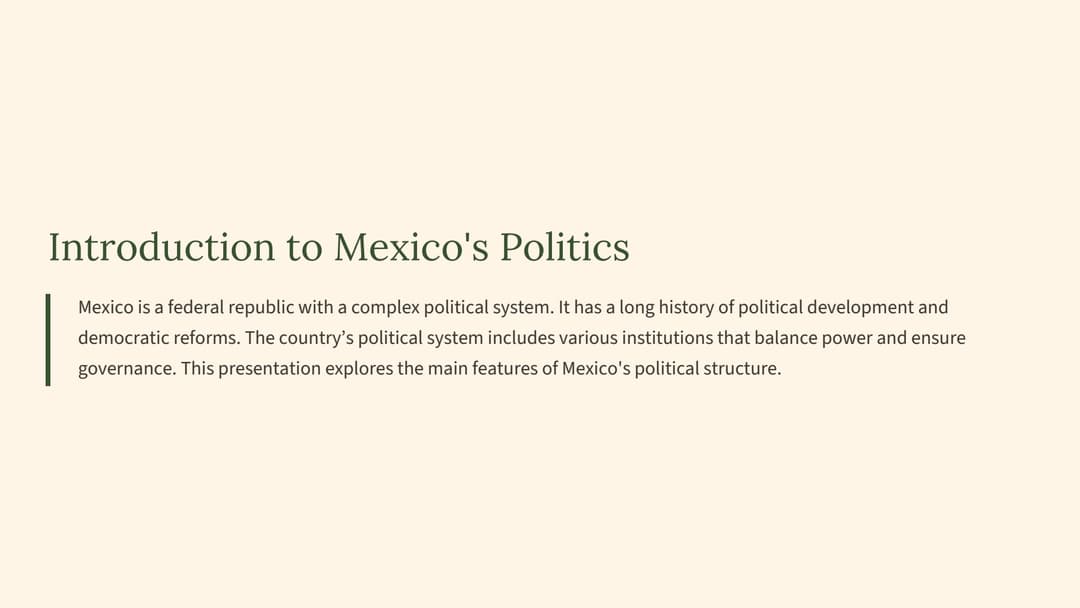
1. Introduction to Mexico's Politics
Mexico is a federal republic with a complex political system. It has a long history of political development and democratic reforms. The country’s political system includes various institutions that balance power and ensure governance. This presentation explores the main features of Mexico's political structure.
2. Constitution of Mexico
The Mexican Constitution is the supreme law of the land. It was adopted in 1917 and establishes the framework for government and laws. The Constitution defines the separation of powers and the rights of citizens. It also outlines the roles of federal and state governments.
3. Executive Branch
The President of Mexico is the head of state and government. The president is elected by direct vote for a six-year term. The executive branch also includes the cabinet and various federal agencies. The president has significant powers but is also subject to checks and balances.
4. Legislative Branch
Mexico has a bicameral Congress, consisting of the Senate and the Chamber of Deputies. Senators serve six-year terms, while deputies serve three-year terms. The legislative branch makes laws, approves budgets, and supervises the executive. Elections are held regularly to renew legislative bodies.
5. Judicial System
The judicial branch includes the Supreme Court of Justice and lower courts. The judiciary interprets laws and ensures their constitutionality. It also protects citizens' rights and resolves legal disputes. The judicial system is independent from other branches.
6. Federal and State Governments
Mexico is divided into states, each with its own government. The federal government handles national issues, while states manage local affairs. States have their own constitutions and elected governors. This division allows for regional autonomy within the country.
7. Electoral System
Elections in Mexico are conducted through a democratic process. Citizens vote for presidents, legislators, and local officials. The electoral system aims to ensure fair representation and transparency. Electoral commissions oversee the voting process.
8. Political Parties
Mexico has a multi-party system with several major parties. The Institutional Revolutionary Party, PAN, and PRD are among the most influential. Political parties compete in elections and influence government policies. The system encourages political pluralism.
9. Challenges and Reforms
Mexico faces challenges such as corruption, violence, and political corruption. Reforms have been introduced to improve transparency and accountability. Ongoing efforts aim to strengthen democratic institutions and promote stability.
10. Conclusion and Summary
Mexico's political system is characterized by its federal structure and democratic principles. It includes separate branches of government that work together to govern the country. Despite challenges, reforms continue to shape a more transparent and effective political environment.
Посмотрите другие работы, которые создали пользователи.
Проект изучает причины и последствия вандализма, а также его влияние на общество. Рассматриваются способы борьбы с этим явлением.
Этот проект изучает плюсы и минусы вакцинации. В нем рассматриваются различные точки зрения и собираются мнения людей через опросы.
Этот реферат посвящен изучению самых значимых открытий в области физики, которые изменили понимание мира. Рассматриваются достижения, раскрывающие законы природы и структуру Вселенной. Важность этих открытий заключается в их влиянии на развитие науки и технологий. Понимание этих открытий помогает лучше понять окружающий мир и способствует прогрессу человечества.
Презентация рассматривает этапы разработки нового сорта мягкой пшеницы, устойчивого к экстремальным условиям северных регионов. В ней описываются методы селекции и основные задачи проекта.
Этот проект изучает, сколько денег тратит подросток за один месяц. В нем рассматриваются основные статьи расходов и их влияние на финансовое состояние подростка.
Проект посвящен изучению английского языка, его правил и особенностей. В работе рассматриваются основные аспекты языка и проводится социальный опрос среди учащихся.
Проект посвящен изучению поведения птиц в зимний период и необходимости их кормления. В работе рассматриваются способы помощи птицам и важность этого для природы.
Проект изучает работу и особенности Бирюсинского гидролизного завода. В нем рассматриваются процессы производства и важность предприятия.
Проект изучает климатические условия региона Крым и их влияние на быт, хозяйство и традиции. В нем рассматриваются особенности климата и его роль в жизни местных жителей.
Проект изучает использование трехмерного моделирования для создания элементов настольных игр. В нем рассматриваются методы разработки и применения 3D моделей в игровой индустрии.
Опишите тему — нейросеть соберёт презентацию со слайдами, тезисами и выводами.