
Загружаем работу
Учтём индивидуальные пожелания, критерии и методичку вашего преподавателя.
Полную презентацию можно получить по почте после оплаты
Посмотрите пример — что говорить по первым слайдам, прежде чем оплатить.
10–15 слайдов
Профессиональный дизайн
Понятная структура
Формат — PPTX
Готовая презентация за несколько минут
Нажмите, если это про вас — ответ анонимный
Название
Миграция и культурное разнообразие (на английском языке, анализ: сравнение российского и зарубежного опыта
Краткое описание
This presentation explores migration and cultural diversity by comparing experiences in Russia and abroad. It highlights differences, challenges, and benefits associated with migration in different contexts.
Текст презентации
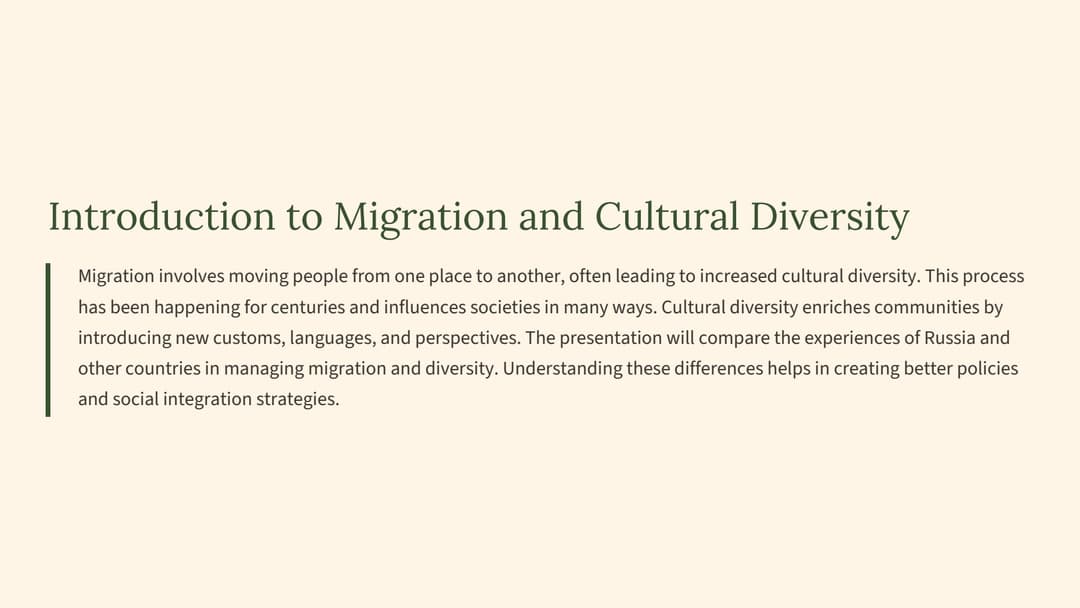
1. Introduction to Migration and Cultural Diversity
Migration involves moving people from one place to another, often leading to increased cultural diversity. This process has been happening for centuries and influences societies in many ways. Cultural diversity enriches communities by introducing new customs, languages, and perspectives. The presentation will compare the experiences of Russia and other countries in managing migration and diversity. Understanding these differences helps in creating better policies and social integration strategies.
2. Historical Background of Migration in Russia
Russia has a long history of migration, including movements during the Soviet era and recent waves of international migration. Historically, migration has been driven by economic, political, and social factors. The Soviet Union promoted internal migration for industrialization, while post-Soviet Russia faces new challenges with international migrants. Migration has contributed to the multicultural fabric of Russian society. However, it also presents challenges related to integration and social cohesion.
3. International Migration Trends in Europe and North America
Many European countries and North America have experienced significant migration flows over the past decades. These regions attract migrants seeking better economic opportunities and safety. Migration has led to multicultural societies with diverse languages, religions, and customs. Countries have developed policies to manage integration, but social tensions sometimes arise. The experience varies widely depending on national policies and social attitudes towards newcomers.
4. Legal Frameworks and Policies in Russia
Russia's migration policies include regulations on work permits, visas, and refugee status. Recent laws aim to control illegal migration and promote legal pathways. The government also implements integration programs, but these are often limited in scope. Challenges include managing large migrant populations and ensuring social cohesion. Policy effectiveness varies, and ongoing reforms are aimed at improving the system.
5. Legal Frameworks and Policies Abroad
Many countries have established comprehensive migration policies that include legal pathways, integration programs, and anti-discrimination laws. European countries often focus on multicultural integration, while North American policies emphasize diversity and inclusion. These policies aim to facilitate migrants' social and economic participation. Challenges include addressing xenophobia and ensuring equal opportunities. Policy success depends on political will and societal support.
6. Cultural Challenges and Opportunities
Migration brings cultural challenges such as language barriers, social integration, and discrimination. At the same time, it offers opportunities for cultural exchange and innovation. Societies that embrace diversity often benefit from new ideas and economic growth. Education, community programs, and inclusive policies play a key role in overcoming challenges. Recognizing and respecting cultural differences is essential for social harmony.
7. Comparison of Russian and Foreign Experiences
Russia's approach to migration is often more restrictive compared to many Western countries that promote multiculturalism. Russian policies tend to focus on control and regulation, while abroad there is more emphasis on integration and inclusion. Social attitudes also differ, affecting how migrants are received and integrated. Both approaches have advantages and disadvantages, and learning from each other can improve migration management.
8. Impact of Migration on Society and Economy
Migration influences societies by enriching cultural diversity and addressing labor shortages. Economically, migrants often fill important roles in various industries. Socially, migration can lead to greater cultural understanding but also to tensions if integration is not managed well. Policies that support social cohesion and economic participation are vital. Overall, migration can be a positive force when managed effectively.
9. Conclusions and Future Perspectives
Effective management of migration and cultural diversity requires balanced policies that promote integration and social cohesion. Both Russia and other countries can learn from each other's experiences to improve their approaches. Addressing challenges such as discrimination and social exclusion is essential for sustainable development. Embracing diversity can lead to more vibrant and resilient societies. Future efforts should focus on inclusive policies and community engagement.
10. Summary and Final Thoughts
Migration and cultural diversity are complex phenomena that shape societies worldwide. Comparing different national experiences reveals valuable insights into effective strategies and common challenges. Embracing diversity offers social and economic benefits, but requires careful planning and inclusive policies. Ongoing dialogue and cooperation are key to managing migration successfully. The goal is to build societies where diversity is seen as an asset and everyone has equal opportunities.
Посмотрите другие работы, которые создали пользователи.
Презентация рассматривает влияние миграции на культурное разнообразие в обществе. Обсуждаются причины миграции, её последствия и роль в формировании мультикультурных сообществ.
Презентация рассматривает теоретические основы и практический опыт применения юмора в рекламных кампаниях как в России, так и за рубежом. Особое внимание уделяется анализу конкретных примеров и эффективности таких методов.
Проект изучает, как юмор применяется в рекламе в разных странах. В работе проводится анализ теоретических основ и практических примеров.
Проект изучает использование юмора в рекламе на примере компании ООО “Айс Крим”. В работе проводится сравнение российского и зарубежного опыта в этой области.
Презентация рассказывает о понятии, истории и применении карттшки. Рассматриваются основные особенности и перспективы развития этого явления.
Презентация посвящена значению русского языка в жизни и развитии одной из русских республик. Рассматриваются история, современное состояние и перспективы использования русского языка. Важность сохранения и развития языка для национальной идентичности и межнационального диалога.
Презентация рассказывает о различных онлайн-инструментах, которые помогают в учебе. Рассматриваются виды инструментов и их преимущества для студентов и школьников.
Эта презентация расскажет о том, почему люди обращаются к картам Таро и верят в эзотерические практики. Рассмотрены причины популярности и психологические основы доверия. Также обсуждаются влияние культуры и традиций на восприятие эзотерики.
Презентация рассказывает о памятниках, связанных с историей крымского ханства, их значении и расположении в Республике Крым. Рассматриваются основные памятники и их роль в культурном наследии региона.
Данная презентация рассказывает о создании и реализации группового учебного проекта по модулю «Робототехника БПЛА». В ней рассматриваются этапы работы, используемые технологии и результаты. Проект помогает понять основные принципы разработки беспилотных летательных аппаратов.
Опишите тему — нейросеть соберёт презентацию со слайдами, тезисами и выводами.